
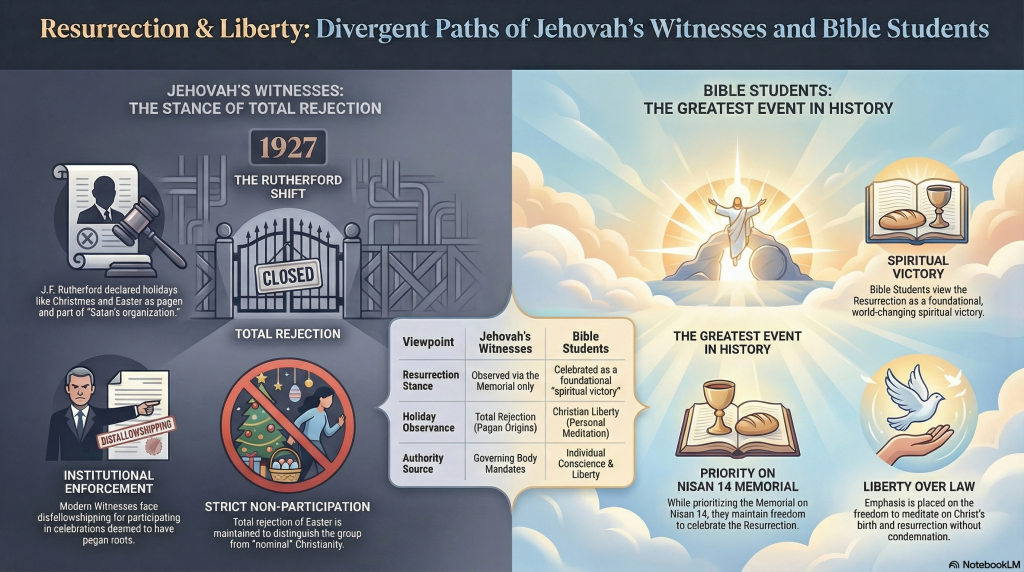
This audio presentation features a compelling and respectful debate between a modern Jehovah’s Witness and a Bible Student (representing the original views of Charles Taze Russell). The discussion centers on one of the most controversial shifts in the movement’s history: the total rejection of holidays vs. the exercise of Christian liberty.
What You Will Hear in This Debate
- The 1927 Turning Point: The Jehovah’s Witness participant explains the “new light” introduced by J.F. Rutherford, who declared that celebrations with pagan origins—originally targeting Christmas in 1927 and later expanding to Easter—were part of “Satan’s organization”.
- The Resurrection as a “World-Changing Event”: The Bible Student counters by arguing that the resurrection of Jesus is a foundational truth so profound it changed the course of human history. They maintain that focusing on the scriptural event is more important than shunning a day due to its potential historical pagan connections.
- Christian Liberty vs. Organizational Rules: A core of the debate focuses on whether a believer should have the “freedom to think” and meditate on the Lord’s life without fear of being disfellowshipped. The Bible Student highlights that under Russell, the Watchtower was a “publishing house” rather than a governing authority that managed every aspect of a believer’s life.
- Memorial vs. Easter Sunday: While both groups prioritize the Nisan 14 Memorial as the primary scriptural command, they disagree on the value of Sunday services. The Bible Student explains why many continue to use the “Memorial season” and Sundays like Palm Sunday for intense devotion and meditation on Jesus’ mission.
- Character Development: The discussion touches on why Bible Students view these seasons as vital for “character development” and growing in the “fruits of the Holy Spirit”—a practice that J.F. Rutherford eventually ridiculed as a “delusion from Satan”.
Why This Debate Matters
This presentation is part of our mission at Beyond the Watchtower to “look to our past for lessons to help inform our future”. By exploring these diverging paths, listeners can better understand whether the modern JW stance is a necessary protection against paganism or an infringement on the “full liberty in Christ” enjoyed by the early Bible Students.
Listen to the full debate to discover the scriptural and historical evidence behind these two very different worldviews.
Scripture Study Sheet: Christian Liberty vs. Organizational Traditions
This study sheet contrasts the scriptural arguments used by Bible Students and Jehovah’s Witnesses regarding the observance of holidays, individual conscience, and the authority of religious traditions.
1. Christian Liberty and Individual Conscience
This theme explores whether a believer is free to celebrate or meditate on scriptural events (like the resurrection) regardless of traditional or potential pagan associations.
- Bible Student Perspective (Liberty in Christ):
- Acts 15:22-33: Used to highlight the “First Ecumenical Council,” which Bible Students interpret as a defense of “Christian Liberty” against the “Yoke of the Law”. They emphasize that while “Liberty is not License,” it protects the believer from rigid human-made rules.
- 1 Timothy 4:10: Highlights that God is the “Savior of all men, specially those who believe”. This supports the view that the benefits of Jesus’ life and resurrection are universal and can be celebrated by all without organizational restriction.
- Matthew 18:15-17: Emphasized as the scriptural way to handle “misunderstandings” and “differences” through personal reconciliation rather than centralized judicial committees.
- Jehovah’s Witness Perspective (Organizational Unity):
- Matthew 10:34: Jesus stated he came to bring “not peace, but a sword”. JWs use this to explain why following “the truth” often requires complete separation from family traditions and holidays, even if it causes division.
- Matthew 24:45-47: Establishes the “Faithful and Discreet Slave”. JWs believe this “Slave” (the Governing Body) is the only authorized channel to provide “spiritual food” and define which practices are acceptable.
2. Rejection of Traditions and “Pagan” Origins
This theme addresses whether the historical origins of a day (like Easter or Christmas) should disqualify its observance by Christians.
- Bible Student Perspective (Focus on Intent):
- 1 Corinthians 2:2: Paul’s determination to know nothing except “Jesus Christ, and him crucified”. Bible Students argue that if the focus of a meditation is Christ’s birth or resurrection, the “pagan connections” are secondary to the spiritual truth being honored.
- Luke 2:10: The “Good News” of great joy which shall be for “all people”. They believe the joy of Christ’s mission is a world-changing event that should be meditated upon freely.
- Jehovah’s Witness Perspective (Separation from the World):
- 2 Corinthians 4:4: Identifies Satan as the “god of this world” who blinds minds. JWs argue that since Satan influences world traditions, holidays like Easter are tools used to mislead believers away from “pure worship”.
- 2 Timothy 3:1-5: Warns that in the last days, men will be “lovers of pleasures more than lovers of God”. JWs use this to condemn the “consumer retail spending” and “pagan origins” of holidays like Halloween and Christmas.
3. The Nature of the “Ransom for All” vs. “Organizational Salvation”
This theme contrasts the scope of Jesus’ sacrifice and who has the right to partake in its symbolic celebrations.
- Bible Student Perspective (The Universal Ransom):
- 1 Timothy 2:6: Jesus gave himself a “Ransom for ALL” to be testified in due time. This is the “pivotal truth” for Bible Students, suggesting that Jesus died for the entire world, not just a specific sect.
- Hebrews 10:32, 33: Encourages believers to endure “reproaches and afflictions” as “companions” to one another. Bible Students emphasize that the strongest and weakest brethren need “sympathy and love” rather than organizational shunning.
- Jehovah’s Witness Perspective (The “Ark” of the Organization):
- Revelation 7:9, 14: JWs identify the “Great Crowd” as an earthly class who must remain associated with the “Anointed” to survive.
- 2 Peter 3:7: Focuses on the “judgment and perdition of ungodly men” by fire. JWs use this to emphasize that only those within the “Ark” of the organization will survive the coming destruction.
Summary of Scriptural Focus
| Topic | Bible Student Focus | Jehovah’s Witness Focus |
| Observance | Individual Liberty (Acts 15:28). | Organizational Harmony (Matt 24:45). |
| Resurrection | “Foundational Hope” for the world. | Pagan connection to be avoided. |
| Salvation | Ransom for All (1 Tim 2:6). | Organizational Survival (The “Ark”). |
| Correction | Personal Reconciliation (Matt 18:15). | Judicial Committees (Shepherd Book). |
Leave a Reply