
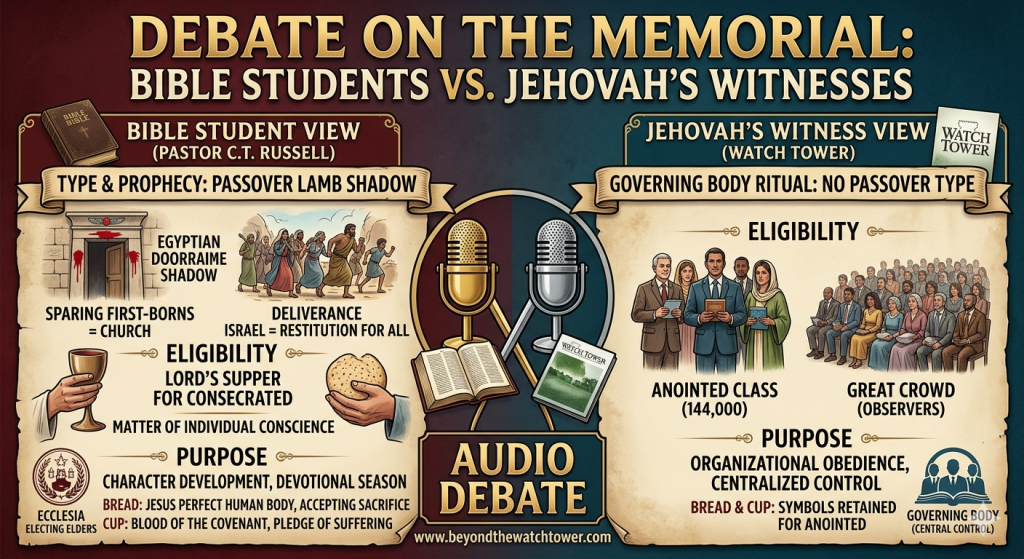
Is the Memorial a personal vow of consecration or an organizational ritual of obedience? In this deep-dive audio debate, we explore the stark theological divide between the original teachings of Charles Taze Russell and the modern practices of Jehovah’s Witnesses.
As the date of Nisan 14 approaches, this discussion unpacks the “Grand Report” of the Memorial, contrasting two very different understandings of Christ’s sacrifice.
Key Topics Covered:
- The Passover Type: How the sparing of the first-borns in Egypt points to the “Church of the First-born,” and why the deliverance of Israel signifies a “Restitution for All” mankind—a hope far broader than modern JW theology allows.
- The Symbols of Bread and Cup: A look at the deeper meaning of the “cup of suffering” and why Bible Students view partaking as a personal pledge of sacrifice.
- The Question of Eligibility: We debate the shift from Individual Conscience (where any consecrated believer may partake) to Organizational Restriction (where participation is limited to a specific “anointed class”).
- Character vs. Control: Is the Memorial a season for “Character Development” and self-examination, or has it become a ritual validating the authority of a Governing Body?
Listen now to hear a respectful but rigorous exchange that challenges the status quo and invites you to reconsider the true purpose of the Lord’s Supper.
A Note on Our Use of Technology
In keeping with our goal to “plant seeds of hope” using innovative tools, we have utilized advanced AI technology to simulate this respectful but spirited debate.
While the voices are AI-generated, the content is strictly grounded in facts. Every argument presented by the “Bible Student” is drawn directly from our 140-year archive, the original teachings of Charles Taze Russell, and the historical records of the early Watchtower movement. This simulation allows us to dramatize the core differences between these two paths while remaining faithful to the scriptural and historical evidence found in our extensive library.
Listen to the full debate below:
Hello Joshua,
Thank you for continuing this dialogue with such a thoughtful, analytical, and respectful approach. You raise several fundamental questions regarding the nature of Christian fellowship, the meaning of the Memorial emblems, scriptural hopes, and church structure.
Your comment brings us directly to the heart of how the early Church operated and how we ought to understand submission to Christ today.
________________________________________
1. “Organization or Christ?” — The Voluntary Association of Believers
You raise a very fair concern when you caution against setting a “personal relationship with Christ” against “the organized Christian congregation.” You are entirely correct that Jesus did not leave Christians as isolated individuals.
Independent Bible Students do not advocate for solitary, detached individualism, nor do they reject organized congregational life. The scriptural model has always been the local, autonomous ecclesia—a voluntary association of consecrated believers gathered together for mutual edification, Bible study, prayer, and the breaking of bread (Acts 2:42; Hebrews 10:24–25).
The true distinction is not between “individualism” versus “congregational fellowship,” but rather between two fundamentally different models of church order:
• Voluntary, Christ-centered fellowship: Where local congregations are autonomous, all members are equal brethren under the sole Headship of Jesus Christ (Matthew 23:8), and elders are elected locally by the congregation through a vote (Acts 14:23).
• Centralized human hierarchy / Ecclesiastical lordship: Where a central corporate organization places itself between the believer and God as an indispensable intermediary, demanding unconditional submission to its interpretations and policy shifts.
Bible Students assemble in local ecclesias and annual conventions worldwide precisely because we value organized Christian fellowship. However, that fellowship is bound by love and common faith, not by submission to a central human administrative authority.
________________________________________
2. The Passover Type and the Meaning of the Memorial Emblems (1 Cor 5:7; 10:16–17; 11:23–28)
You highlight Paul’s words in 1 Corinthians 10:16–17, where he connects the bread with “the body of Christ” (“Because there is one loaf, we, though many, are one body”).
To fully appreciate the Memorial, we must examine its foundational type in the Old Testament. As Paul explicitly states, “Christ our Passover is sacrificed for us; therefore let us keep the feast” (1 Corinthians 5:7–8).
• The Typical Passover (Exodus 12): In Egypt, the blood of the Passover lamb was applied to the doorposts to spare the firstborns of Israel during the night. The next morning, the entire nation of Israel was delivered out of bondage.
• The Antitypical Passover: During this Gospel Age “night,” the blood of Jesus, the true Lamb of God (John 1:29), covers the “Church of the Firstborn” (Hebrews 12:23). During the coming Millennial “morning,” the Restitution blessings of deliverance will flow to the entire world of mankind (Acts 3:19–21).
When Jesus instituted the Memorial Supper, He gave a direct, unqualified command to His followers: “Take, eat; this is my body… Drink ye all of it” (Matthew 26:26–27). He added the solemn warning in John 6:53: “Except ye eat the flesh of the Son of man, and drink his blood, ye have no life in you.”
Paul further explained the dual significance of the emblems:
1. Primary Meaning: Accepting Jesus’ perfect human sacrifice as the Ransom price for our sins (1 Timothy 2:5–6).
2. Secondary Meaning (1 Cor 10:16–17): The joint-participation (koinonia / “communion”) of Christ’s body members who share in His sacrificial death (“broken with Him”) to reign with Him in glory (Romans 8:17; 2 Timothy 2:11–12).
Paul instructed the believers in Corinth: “But let a man examine himself, and so let him eat of that bread, and drink of that cup” (1 Corinthians 11:28). Scripture places the responsibility of self-examination on the individual conscience of each consecrated believer before God.
Nowhere in the New Testament did Jesus or the Apostles authorize any human organization to pass the emblems past millions of believers as mere spectators, nor to divide consecrated Christians into “partakers” and “non-partakers.” Refusing the emblems obscures the very antitypical role of the Firstborn.
________________________________________
3. Scriptural Hopes and the Location of the “Great Crowd” (Revelation 7)
You cite Luke 12:32 (“Little Flock”) alongside Revelation 7:4, 9 and 14:1–3 to argue that because the New Testament presents different Christian hopes, partaking cannot simply be a matter of individual conscience.
Bible Students fully recognize that God’s grand Plan of the Ages includes distinct classes and rewards:
1. The Little Flock (Bride of Christ): The 144,000 who walk the “narrow way” faithfully, gaining the divine nature as joint-heirs with Christ in the heavenly Kingdom (Luke 12:32; Revelation 14:1–5; 2 Peter 1:4).
2. The Great Crowd (Great Company): A secondary spiritual class described in Revelation 7:9, 14–15 who, through lack of zeal, miss the chief prize of the Little Flock, but wash their robes in the blood of the Lamb.
3. The World of Mankind: The billions of humanity who will inherit a perfected, paradise Earth during the Millennial “Restitution of all things” (Acts 3:19–21; Psalm 37:29; Isaiah 35).
Crucially, however, notice where Revelation 7:9, 15 explicitly places the “Great Crowd”:
“After this I beheld, and, lo, a great multitude… stood before the throne, and before the Lamb… Therefore are they before the throne of God, and serve him day and night in his temple (naos).”
In Greek, naos refers to the inner sanctuary—the heavenly realm. The Great Crowd in Revelation 7 is a heavenly, spiritual class, not an earthly class living on Paradise Earth.
During this present Gospel Age, Scripture declares that there is “one hope of your calling” (Ephesians 4:4)—the heavenly calling to follow in Jesus’ footsteps. The earthly Restitution of mankind belongs to the upcoming Millennial Age (Acts 3:19–21). Reclassifying the Great Crowd in 1935 as an earthly class forbidden from partaking of the Memorial emblems distorts both Revelation 7 and Ephesians 4:4. Every consecrated believer who accepts Jesus as their Redeemer has the scriptural privilege and duty to examine their own heart and partake.
________________________________________
4. Acts 15, Cheirotoneo, and the Danger of Nicolaitanism
You return to Acts 15 to argue that the Jerusalem council demonstrates centralized direction over all congregations rather than “absolute independence.”
When we re-examine the New Testament record, several key facts emerge:
• The Jerusalem meeting (Acts 15) was an ad hoc emergency conference called specifically to resolve a local crisis caused by teachers from Judea who insisted that Gentile converts in Antioch must keep the Law of Moses (Acts 15:1–2).
• Once the apostles and elders established scriptural harmony, the letter sent to the Gentile congregations was a decree of Christian liberty: “For it seemed good to the Holy Ghost, and to us, to lay upon you no greater burden than these necessary things” (Acts 15:28).
• The Jerusalem conference did not establish a permanent, administrative “Governing Body” that issued ongoing organizational literature, managed local meeting properties, mandated service report quotas, or appointed local elders.
Scripturally, local ecclesias remained autonomous. In Acts 14:23, when elders were appointed in every church, the Greek word used is cheirotoneo, which literally means “to elect by stretching forth the hand”—a democratic election by the local congregation itself (as documented in Young’s and Strong’s concordances).
Furthermore, the Apostle Paul prophetically warned the Ephesian elders in Acts 20:29–30 that after his departure, “grievous wolves shall enter in among you, not sparing the flock. Also of your own selves shall men arise, speaking perverse things, to draw away disciples after them.”
When men began lording over God’s heritage, centralizing authority and creating a separate clergy/ruling class, Jesus condemned this in Revelation 2:6, 15 as “Nicolaitanism” (from nikao = to conquer, and laos = the people).
________________________________________
5. Submitting to Christ and True Love (John 13:35)
We wholeheartedly join you in upholding Jesus’ words in John 13:35: “By this all will know that you are my disciples, if you have love among yourselves.”
You conclude by asking: “Are we submitting to Christ, his Word, and the arrangement of the Christian congregation?”
We agree that this is the central question! But let us consider what true submission to Christ entails:
• When a human organization places itself between the believer and Christ—claiming to be “God’s sole channel,” redefining Christ’s explicit commands, forbidding believers from partaking of the Lord’s Memorial, and disfellowshipping those who humbly test doctrines against Scripture like the noble Bereans (Acts 17:11)—then unconditional submission to that organization becomes infidelity to Christ.
True Christian unity and love cannot be produced by organizational enforcement or required conformity to human dogmas. True unity is the “unity of the Spirit” (Ephesians 4:3)—a voluntary, heart-harmony rooted in a shared love for our Redeemer, an unreserved submission to His Word, and mutual respect for the Christian liberty of every brother and sister.
In Christian love,
Peter K. (Admin)
Hello Joshua,
Thank you for continuing this dialogue with such a respectful and analytical approach. You raise several fundamental questions regarding the nature of Christian fellowship, the meaning of the Memorial emblems, scriptural hopes, and church structure.
Your comment brings us directly to the heart of how the early Church operated and how we ought to understand submission to Christ today.
—
#### 1. “Organization or Christ?” — Addressing the Supposed False Dichotomy
You raise a very fair concern when you caution against setting a “personal relationship with Christ” against “the organized Christian congregation.” You are entirely correct that Jesus did not leave Christians as isolated individuals.
Independent Bible Students do **not** advocate for solitary, detached individualism, nor do they reject organized congregational life. The scriptural model has always been the local, autonomous **ecclesia**—a voluntary association of consecrated believers gathered together for mutual edification, Bible study, prayer, and the breaking of bread (Acts 2:42; Hebrews 10:24–25).
The true distinction is not between “individualism” versus “congregational fellowship,” but rather between:
* **Voluntary, Christ-centered fellowship:** Where local congregations are autonomous, all members are equal brethren under the sole Headship of Jesus Christ (Matthew 23:8), and elders are elected locally by the congregation to serve the flock (Acts 14:23).
* **Centralized human hierarchy / Ecclesiastical lordship:** Where a central corporate organization places itself between the believer and God as an indispensable intermediary, demanding unconditional submission to its interpretations and policy shifts.
Bible Students assemble in local *ecclesias* and annual conventions worldwide precisely because we value organized Christian fellowship. However, that fellowship is bound by love and common faith, not by submission to a central human administrative authority.
—
#### 2. The Memorial Emblems and 1 Corinthians 10:16–17 / 11:23–26
You highlight Paul’s words in 1 Corinthians 10:16–17, where he connects the bread with “the body of Christ” (*”Because there is one loaf, we, though many, are one body”*).
We agree that this passage carries a profound spiritual meaning. In Bible Student understanding, the “one loaf” represents both the literal body of Jesus offered as the Ransom price for the world (1 Timothy 2:5–6; John 6:51) and the joint participation (*koinonia* / “communion”) of Christ’s consecrated footstep followers who are called to be broken with Him and share in His sacrificial death (Romans 12:1; 2 Timothy 2:11–12; 1 Corinthians 10:16).
However, when examining who should partake of these emblems, we must look at Jesus’ direct command and Paul’s explicit instructions:
* Jesus said to His followers without qualification: *”Take, eat; this is my body… Drink ye all of it”* (Matthew 26:26–27) and *”Do this in remembrance of me”* (1 Corinthians 11:24–25).
* Jesus also declared in John 6:53: *”Except ye eat the flesh of the Son of man, and drink his blood, ye have no life in you.”*
* Paul instructed the believers in Corinth: *”But let a man **examine himself**, and so let him eat of that bread, and drink of that cup”* (1 Corinthians 11:28).
Scripture places the responsibility of examination on the **individual conscience** of each consecrated believer before God. Nowhere in the New Testament did Jesus or the Apostles instruct that the Memorial emblems should be passed *past* millions of believers as mere spectators, nor did they authorize any organization to classify believers into “partakers” and “non-partakers.”
—
#### 3. Eligibility to Partake and the Question of Dual Hopes
You cite Luke 12:32 (“Little Flock”) alongside Revelation 7:4, 9 and 14:1–3 to argue that because the New Testament presents different Christian hopes, partaking cannot simply be a matter of individual conscience.
Bible Students fully recognize that God’s grand Plan of the Ages includes distinct rewards and hopes:
1. **The Little Flock (Bride of Christ):** The 144,000 who walk the “narrow way” faithfully, gaining the divine nature as joint-heirs with Christ in the heavenly Kingdom (Luke 12:32; Revelation 14:1–5; 2 Peter 1:4).
2. **The Great Crowd (Great Company):** A secondary spiritual class described in Revelation 7:9, 14–15 who, through lack of zeal, miss the chief prize of the Little Flock, but wash their robes in the blood of the Lamb and serve God *”before the throne”* and in His temple (*naos*).
3. **The World of Mankind:** The billions of humanity who will inherit a perfected, paradise Earth during the Millennial “Restitution of all things” (Acts 3:19–21; Psalm 37:29; Isaiah 35).
Crucially, however, during this present Gospel Age, the Apostle Paul declares that there is **”one hope of your calling”** (Ephesians 4:4)—the High Calling to sacrifice and reign with Christ (Romans 8:17).
Notice that the “Great Crowd” in Revelation 7:9, 15 is explicitly located in **heaven** (*”before the throne of God”* and serving in His heavenly temple). They are not an earthly class instructed to refrain from partaking during the Gospel Age. Refusing the Memorial emblems based on an organizational reclassification introduced in 1935 has no scriptural foundation. Every consecrated believer who accepts Jesus as their Redeemer and Sin-bearer has the privilege and duty to partake, examining their own heart before the Lord.
—
#### 4. Acts 15 and the Nature of Jerusalem’s Direction
You return to Acts 15 to argue that the Jerusalem council demonstrates centralized direction over all congregations rather than “absolute independence.”
When we re-examine Acts 15, several key facts emerge:
* The meeting was an **ad hoc emergency conference** called specifically to resolve a local crisis that arose when teachers from Judea insisted that Gentile converts in Antioch must be circumcised and keep the Law of Moses (Acts 15:1–2).
* Once the apostles and elders established scriptural harmony under the Holy Spirit, the letter they sent to the Gentile congregations was a decree of **Christian liberty**: *”For it seemed good to the Holy Ghost, and to us, to lay upon you **no greater burden than these necessary things**”* (Acts 15:28).
* The Jerusalem conference did not create a permanent, administrative “Governing Body” that issued ongoing organizational literature, managed local meeting properties, mandated service report quotas, or appointed local elders.
Scripturally, local *ecclesias* remained autonomous. New Testament elders and deacons were chosen locally by the congregation itself through a vote—the Greek word used in Acts 14:23 being *cheirotoneo*, which literally means “to elect by stretching forth the hand.”
—
#### 5. Submitting to Christ and True Love (John 13:35)
We wholeheartedly join you in upholding Jesus’ words in John 13:35: *”By this all will know that you are my disciples, if you have love among yourselves.”*
True Christian unity and love cannot be produced by organizational enforcement, centralized administration, or required conformity to human dogmas. True unity is the **”unity of the Spirit”** (Ephesians 4:3)—a voluntary, heart-harmony rooted in a shared love for our Redeemer, an unreserved submission to His Word, and mutual respect for the Christian liberty of every brother and sister.
The real question, as you rightly state, is: *Are we submitting to Christ, His Word, and the arrangement of the Christian congregation?*
When we submit to Christ as our sole Head, we recognize that His arrangement for the Church during the Gospel Age is a voluntary association of free believers, gathered under the Word of God, bound by love, and looking forward to the glorious fulfillment of His Kingdom.
In Christian love,
Peter K. (Admin)
The issue of who is eligible to partake of the emblem at the Memorial of Jesus’ Death can be addressed by examining the accounts of the events, as recorded in the four gospels, to determine whether Judas partook of the emblems.
If he did so, it suggests that any follower of Jesus may also partake of the emblems, regardless of their current spiritual state.
A careful study of the four gospels demonstrates that all accounts are consistent in showing that Judas left the gathering after partaking of the emblems.
The account in Luke is particularly illustrative, as Jesus identified Judas as the traitor while he was still seated at the table with Him (Luke 22:21), and this identification occurred after the partaking of the emblems (Luke 22:17-20).
In Matthew’s account, it is noteworthy that when Jesus offered the cup saying, “Drink from it, all of you,” Judas was still present with the others as they shared the cup (Matthew 26:27).
Mark also indicates that “all drank from it,” implying that all twelve apostles were present at that time (Mark 14:17, 23).
In the Gospel of John, the Passover meal, the Lord’s meal, and the act of partaking all took place consecutively, immediately before Jesus washed the feet of His disciples. At that moment, Jesus said, “You are clean, but not all of you,” acknowledging that Judas, who was present, was the one who was not clean (John 13:2, 5, 10).