
Program Description
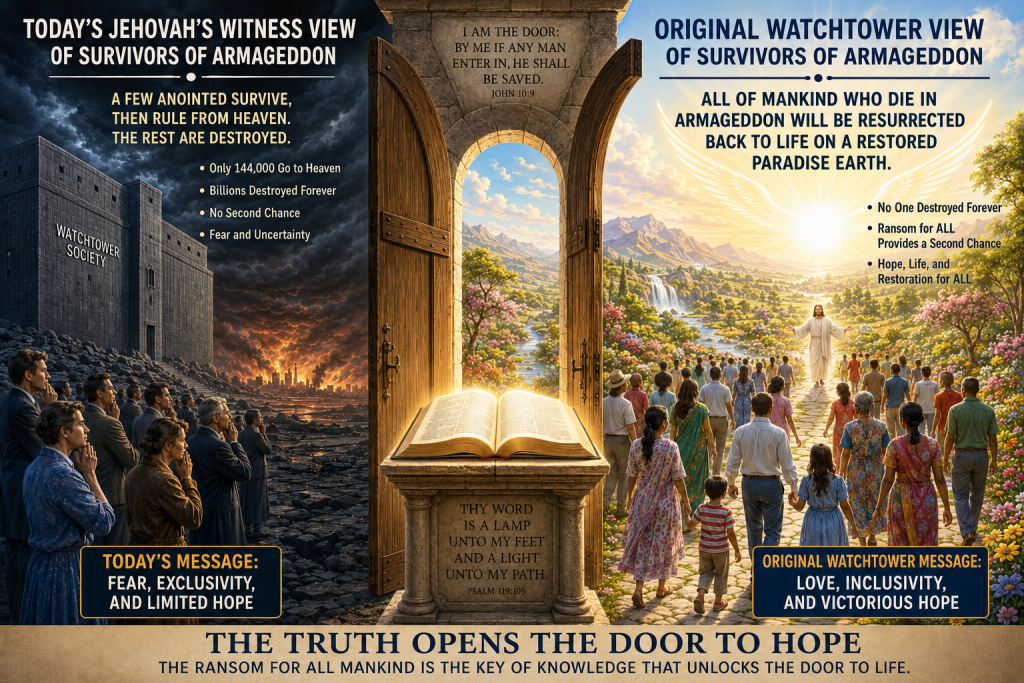
For many, the word Armageddon triggers a paralyzing fear of “final destruction” and “Second Death.” Modern teachings often insist that survival is restricted to an “organizational Ark,” leaving billions—including neighbors and unbaptized loved ones—with no hope of resurrection.
But what if the “final exam” for humanity isn’t happening today?
In this special program, we journey into the archives to rediscover a “brighter result” for this climatic event. We uncover the historical shift in 1923 that moved the “Sheep and Goats” judgment from the future to the present, turning a message of global hope into a sentence of organizational doom.
Join us as we explore:
- The Ransom for ALL: Why Jesus’ sacrifice is fully efficacious for the entire human race.
- A Fair Trial for Life: The difference between an “execution” and a thousand-year “trial” during the Millennium.
- Character over Compliance: Finding peace in “full liberty in Christ” rather than organizational fear.
Welcome to the “Fear Free Zone,” where we look to our past for lessons that inform a hopeful future.
——————————————————————————–
A Note on Our Process
We value full transparency. This program was developed with the assistance of AI acting as our “digital librarian”—instantly searching and synthesizing tens of thousands of pages of historical Bible Student records [Notebook State]. However, just like an orchestra conductor, the content is carefully reviewed and controlled by Bible Students. This ensures that every note is in harmony with Bible Student views and the original scriptural research we cherish
With full liberty in Christ and inspired by1 Corinthians 11:19, here are my observations regarding your answer to my question #1:
With all due respect to the memory of Pastor Russell and acknowledging my own limitations, I still maintain the understanding that Jesus appeared on earth in a temporary human body after His visible resurrection, as exemplified before. However, He was transformed from His human body into a spiritual body within the cloud that caught Him up, a phenomenon that may be inferred from the description in Matthew 17:2-5, the event known as the Transfiguration of Jesus.
Therefore, He permanently remains a life-giving spirit at the right hand of His Father, where He belongs forever. The term “manner,” as applied to His ascension with a clearly visible human body, aptly describes the way He was resurrected.
Jesus was resurrected in spirit; however, this does not preclude the possibility that he could reincarnate at will thereafter. This is supported by his unexpected appearances to his apostles. Additionally, when Adam and Eve encountered and communicated with Jehovah face-to-face in the Garden of Eden before the original sin, it is described that He was “walking in the breeze part of the day,” and Adam hid from Him among the vegetation (Gen 3:8-10). These details suggest that God was in an incarnate form at that time.
In Genesis 18:1–2 and 22, Jehovah appeared to Abraham, who observed three men. The narrative distinguishes Jehovah from the two angels who later went to Sodom (Genesis 19:1). In Genesis 18:5–8, Abraham prepared food for them, which they accepted and consumed.
In Luke 24:39–43, Jesus stated, “A spirit does not have flesh and bones, as you see that I have,” affirming the reality of his physical body following his resurrection.
These insights concerning the incarnation of the spirit do not necessarily contradict 1 Peter 3:18 or Exodus 33:20 when understood in terms of spirit form rather than incarnate form.
Our physical bodies will not be physically extracted from the graves; rather, along with our spirit from the “memorial graves,” in a new new physical condition on the restored earth, as indicated in Psalm 37:29.
I acknowledge that my responses may not be exhaustive, but we are all continuously progressing toward a deeper understanding of the path of righteousness. (Prov. 4:18)
Dear Mihai,
Thank you for your warm, gracious, and scripturally rich message. It is a genuine privilege to correspond with a fellow student of the Word who approaches the Scriptures with such diligence, open-mindedness, and reverence.
Your reference to **1 Corinthians 11:19**—that differences of perspective allow approved character and deeper scriptural truth to be made manifest—provides a wonderful, Christlike framework for our ongoing dialogue. Your humble quote of **Proverbs 4:18** (*”the path of the just is as the shining light, that shineth more and more unto the perfect day”*) reflects the true Berean spirit (Acts 17:11).
You have raised several very specific, well-reasoned scriptural points regarding the nature of Christ’s resurrection, His post-resurrection appearances, Old Testament manifestations, the Transfiguration, and human resurrection.
Below is a further deepened, detailed, and scripturally grounded examination of each of these areas to bring complete clarity to the topic.
—
### 1. Scriptural Definitions: “Incarnation,” “Reincarnation,” and “Materialization”
In your comment, you suggest that Jesus was resurrected in spirit, but that He could “reincarnate at will thereafter,” or that He retained a human body until transformed inside the cloud at His ascension.
To ensure absolute precision, it is helpful to examine how Scripture distinguishes these three concepts:
* **Reincarnation:** A non-biblical concept where a soul migrates through a succession of lives or physical bodies. Scripture explicitly rejects this, declaring that *”it is appointed unto men once to die”* (Hebrews 9:27).
* **Incarnation (“The Word Made Flesh”):** In John 1:14, we read: *”The Word was made flesh, and dwelt among us.”* The Logos humbled Himself, leaving His pre-human spirit nature to be born as a genuine human child (Philippians 2:7–8; 1 Timothy 2:5). This exchange of nature from spirit to human occurred **once**. Jesus was not a mixture of two natures (spirit and human at the same time); He was fully human (*”the man Christ Jesus”*) during His earthly ministry.
* **Materialization:** The divine power granted to spirit beings to temporarily create and assume a physical body of flesh and blood for a specific mission, and then dissolve that body back into its constituent elements when the mission is completed.
#### Old Testament Manifestations (Genesis 3:8; 18:1–8; 19:1)
You cite Genesis 3:8–10 (God/angels walking in Eden) and Genesis 18:1–8 (the three “men” who ate food with Abraham) as examples of incarnation.
These Old Testament accounts are classic examples of **materialization**:
* The three “men” who visited Abraham (Genesis 18:1–2) were heavenly spirit messengers. Two of them are explicitly identified in Genesis 19:1 as **angels** who traveled on to Sodom.
* To communicate with Abraham and Lot, these spirit angels materialized human bodies capable of walking, talking, and eating literal food (Genesis 18:8).
* They were not “incarnated” humans, nor had they undergone reincarnation. Once their message was delivered, those materialized bodies ceased to exist.
In the exact same way, during the 40 days following His resurrection, the resurrected Lord Jesus—now an exalted spirit being—used this same divine power of **materialization** to appear to His disciples.
—
### 2. Luke 24:39 and Post-Resurrection Appearances: “Flesh and Bones” vs. “Flesh and Blood”
You cite Luke 24:39 (*”A spirit hath not flesh and bones, as ye see me have”*) and Jesus eating broiled fish as evidence that He retained a physical body after His resurrection.
When we examine all of Jesus’ post-resurrection appearances together, the scriptural facts demonstrate that these were temporary materializations:
1. **”Flesh and Bones” vs. “Flesh and Blood”:** Notice that in Luke 24:39, Jesus specifically said “flesh and **bones**”—He deliberately omitted “blood”! Why? Because *”the life of the flesh is in the blood”* (Leviticus 17:11) and the Apostle Paul explicitly declares that **_”flesh and blood cannot inherit the kingdom of God”_** (1 Corinthians 15:50). Jesus demonstrated that the materialized body of flesh and bone was real to touch, but it was not His permanent heavenly condition.
2. **1 Corinthians 15:44–47 Contrast:** Paul explicitly defines the nature of resurrection bodies: *”It is sown a natural body; **it is raised a spiritual body**… The first man is of the earth, earthy: **the second man is the Lord from heaven**.”*
3. **Appearing in “Another Form” (Mark 16:12; Luke 24:15–31):** On resurrection morning, Mary Magdalene did not recognize Jesus, mistaking Him for the gardener (John 20:15). Later that day, two disciples walked with Him for miles on the road to Emmaus, yet failed to recognize Him. Mark 16:12 explicitly records that **_”he appeared in another form unto two of them.”_** It was only when He broke bread that their eyes were opened, and instantly He **vanished out of their sight** (Luke 24:31).
4. **Passing Through Locked Doors (John 20:19, 26):** That same evening, while the disciples were gathered in an upper room with the doors bolted for fear of the Jews, Jesus suddenly materialized in their midst.
5. **Why Did He Materialize?** If Jesus had been raised in His literal former human body, His intimate companions would have recognized Him immediately on every occasion. Instead, He appeared in different forms and vanished at will to teach them two vital lessons:
* That He was no longer dead, but alive.
* That He was no longer a man of flesh, but a spirit being who could appear and disappear at will, just as angels had done in the Old Testament.
6. **Saul of Tarsus (Acts 9:3–9; 1 Cor 15:8):** When Saul saw the resurrected Lord on the road to Damascus, Jesus did not materialize a fleshly body. He appeared in His unshielded, glorified spirit person—shining above the brightness of the sun, which struck Saul blind. Paul later explained that he saw the Lord *”as one born out of due time”* (1 Corinthians 15:8), catching an advance glimpse of how Christ exists in His heavenly glory.
—
### 3. The Ransom (*Antilutron*) Barrier: Why Jesus Cannot Retain Human Flesh
The most decisive scriptural barrier to Jesus retaining or re-assuming a human body lies in the doctrine of the **Ransom (*Antilutron*)**.
In 1 Timothy 2:5–6, Paul writes:
> *”For there is one God, and one mediator between God and men, **the man Christ Jesus; who gave himself a ransom (*antilutron*) for all**, to be testified in due time.”*
* **The Meaning of *Antilutron*:** The Greek word *antilutron* literally means **”a corresponding price”**—an exact substitutionary equivalent (from *anti* = corresponding to, and *lutron* = price).
* **What Was Lost vs. What Was Paid:** Father Adam was a perfect **human being** who sinned, forfeiting perfect human life and a human body for himself and his unborn race.
* **Giving His Flesh Forever:** Jesus declared in John 6:51: *”The bread that I will give is **my flesh, which I will give for the life of the world**”*.
* **No Taking Back the Sacrifice:** As Pastor Russell highlighted, Jesus sacrificed His human nature **forever**. When He died on Calvary, He *”poured out his soul unto death”* (Isaiah 53:12).
If Jesus were to re-assume or retain His human body of flesh, He would be taking back the very Ransom price paid for Adam and his race, leaving humanity unredeemed! As Hebrews 10:10 concludes, we are sanctified *”through the offering of the body of Jesus Christ **once for all**.”*
—
### 4. The Transfiguration (Matt 17:2–5) & Acts 1:11 (*Tropos*)
You suggest that the Transfiguration in Matthew 17:2–5 illustrates Jesus transforming from a human body into a spirit body inside the cloud at His ascension.
Scripture provides its own interpretation of the Transfiguration:
* In Matthew 17:9, Jesus explicitly told the disciples: *”Tell the **vision** (*horama*) to no man, until the Son of man be risen again from the dead.”* It was a symbolic, prophetic vision.
* In 2 Peter 1:16–18, Peter explains that the Transfiguration was a preview/display of the **power and presence (*parousia*)** of Christ in His glorified Kingdom.
Regarding **Acts 1:11** (*”shall so come in like manner as ye have seen him go”*):
* The Greek text uses the word **_tropos_** (“manner” or “way”). It does not say He would return in the same *body*, but in the same *manner*.
* How did He go? Quietly, secretly, unobserved by the world, known only to His faithful disciples.
* In *like manner* (*tropos*), His return begins quietly, secretly, and unobserved by the world (“as a thief”, 1 Thess 5:2; 2 Peter 3:10; Rev 16:15), recognized initially only by those whose “eyes of understanding” (*ophthalmos*, Ephesians 1:18) are enlightened.
—
### 5. Human Resurrection and the “Memorial Graves” (John 5:28–29 / Psalm 37:29)
Your observation regarding human resurrection is exceptionally clear, insightful, and scripturally sound!
You rightly note that physical bodies will not be dug up atom-by-atom out of literal graves, but that souls will be awakened from the “memorial tombs” (*mnemeion*) in a new physical condition to inherit a restored Paradise Earth (Psalm 37:29; John 5:28–29).
This harmonizes perfectly with 1 Corinthians 15:37–38:
> *”And that which thou sowest, **thou sowest not that body that shall be**… but God giveth it a body as it hath pleased him.”*
Scripture outlines two distinct salvations and resurrective rewards:
1. **The First Resurrection (Heavenly / Spiritual):** The Church class (“Little Flock”) is raised in a spiritual body, gaining immortality and the divine nature to reign with Christ (1 Corinthians 15:44, 52–54; 1 Peter 1:3–4; Revelation 20:6).
2. **The Restitution Resurrection (Earthly / Human):** The World of Mankind is awakened from the sleep of death unto a resurrection of trial/judgment, receiving perfected human bodies during the Millennial **”Times of Restitution of all things”** (Acts 3:19–21; John 5:28–29; Isaiah 35:1–10).
—
### Conclusion
Mihai, your earnest desire to dig deeply into the Word of God is inspiring. Though we may examine these prophetic and lexical details from complementary angles, we share the exact same divine foundation: **faith in the all-sufficient Ransom sacrifice of our Redeemer, Jesus Christ, and eager anticipation of His glorious Kingdom of Restitution!**
As we both continue walking along “the path of the righteous” (Proverbs 4:18), may Jehovah grant us increasing light, wisdom, and Christian love.
In Christian love and fellowship,
Peter K. (Admin)
In response to your previous reply, I continue to have questions regarding the manner in which the anticipated return of Jesus will occur, particularly in relation to the events of the Battle of Armageddon.
#1 Will it be possible that He will return in his reincarnated body and visible to all, as mentioned in Matthew 24:27 and 30? This scenario resembles how He was seen by his apostles during His ascension, as described in Acts 1:11 and also exemplified by instances shortly after His resurrection when He appeared in the flesh to his apostles—engaging in conversations, sharing meals with His disciples, and inviting Doubting Thomas to touch His wounds, as recorded in Luke 24:15, 30-31, 36, 39, 41-43, and John 20:27.
#2 Is 1 Timothy 6:16 and 1 Peter 3:18 in reference solely to His appearance in the spiritual realm, where He resides at the right hand of His Father since his ascension to the sky? (1 Timothy 6:16; 1 Peter 3:18)
#3 When Jesus stated, “Before long, the world will not see me anymore, but you will see me” (John 14:19), is this because of his temporary absence from public view after his resurrection—as has been the case up to this point—until his return, when He will executes his glorious judgment, as described in Revelation 19:11–19, when the “heaven stood open” and Jesus descends visibly as a victorious warrior?
#4 Is there contradiction between Revelation 19:11–19, when the “heaven stood open” and Jesus descends visibly as a victorious warrior, and the interpretation that He will continue to be invisible, once the Armageddon war will be revealed visibly to anyone and also after the world leaders visibly assemble their global military forces for the conflict, as referenced in Revelation 16:13–16?
#5 Based on most circulated opinions, the ancient Greeks used the term “Parousia” denote both an act and a state of being, signifying a sudden arrival and an ongoing presence. Does this term accurately describe in the big picture Jesus’ visible, unexpected and unique return, followed by his continual presence to carry out the final judgment of the world?
#6 Does the King assume his great power, as indicated in Psalm 2:9 and Revelation 2:27, to break the nations in order to defeat all their authorities on the earth at His arrival, rather than being limited solely to the non-Jewish inhabitants of the Promised Land?
Hello Mihai,
It is always a privilege to engage with your earnest, deeply considered scriptural inquiries. You have presented six key questions regarding the manner of our Lord’s return, the nature of His glorified resurrection body, the interpretation of symbolic apocalyptic visions, and the ultimate divine purpose of the Battle of Armageddon.
Below is an in-depth scriptural, lexical, and historical response to each of your points, drawing directly upon the total harmony of Scripture and the Bible Student perspective.
________________________________________
#1. Will Jesus return in a reincarnated, visible body of flesh?
The Scriptures explicitly teach that Jesus will not return in a physical body of flesh.
• The Nature of His Resurrection: The Apostle Peter gives a direct, literal statement regarding the nature of Christ’s resurrection: “For Christ also hath once suffered for sins, the just for the unjust, that he might bring us to God, being put to death in the flesh, but quickened [made alive] in the spirit” (1 Peter 3:18). Jesus was not restored to human nature, but was raised as a “life-giving spirit” (1 Corinthians 15:45) and exalted to the divine nature (Philippians 2:9–11; 2 Peter 1:4). In 1 Corinthians 15:50, Paul explicitly declares that “flesh and blood cannot inherit the kingdom of God.”
• The Law of the Ransom (Antilutron): This truth is anchored in the foundational mathematics of Redemption. In 1 Timothy 2:5–6, Paul writes: “The man Christ Jesus; who gave himself a ransom (antilutron) for all”. The Greek word antilutron signifies “a corresponding price”. Father Adam was a perfect human being who sinned and forfeited perfect human life for himself and his offspring. To satisfy Divine Justice, Jesus offered His perfect human life and body as an exact corresponding sacrifice. Jesus declared: “the bread that I will give is my flesh, which I will give for the life of the world” (John 6:51). As Pastor Russell emphasized, if Jesus were to take back His human body of flesh, humanity would lose the redemption price paid for their salvation! He surrendered His human nature forever—he “poured out his soul unto death” (Isaiah 53:12).
• Post-Resurrection Materializations: During the 40 days prior to His ascension, Jesus was already a resurrected spirit being who materialized physical bodies on various occasions (appearing in different forms, such as a gardener in John 20:15 or a traveler in Luke 24:13–31) to convince His disciples that He was alive. These materialized bodies were not His glorified spirit person, as proven by His ability to appear inside locked rooms without opening doors (John 20:19, 26) and to vanish instantly out of sight (Luke 24:31).
• The “Manner” of Ascension (Acts 1:11): In Acts 1:11, the angels told the apostles: “This same Jesus, which is taken up from you into heaven, shall so come in like manner as ye have seen him go into heaven”. The Greek text uses the word tropos (“manner” or “way”), not morphe (physical shape). How did He go? Quietly, secretly, unobserved by the world, known only to His faithful disciples. In like manner (tropos), His return begins quietly, secretly, and unobserved by the world, recognized initially only by those watching with the “eyes of understanding” (Ephesians 1:18).
Find more here about Jesus is an invisible spirit being after his resurrection: https://www.beyondwatchtower.com/2010/11/11/does-jesus-have-a-body-of-flesh-3/
________________________________________
#2. Do 1 Timothy 6:16 and 1 Peter 3:18 refer solely to His spirit realm appearance?
Yes. Both passages are plain, literal statements regarding the glorified Christ’s divine spirit nature.
In 1 Timothy 6:16, Paul explicitly states that the resurrected, glorified Lord: “…only hath immortality, dwelling in the light which no man can approach unto; whom no man hath seen, nor can see…”.
This is a literal physical statement. When Saul of Tarsus caught merely a partial, indirect flash of Christ’s glorified spirit presence on the road to Damascus, he was struck completely blind by its supernatural brilliance (Acts 9:3–9; 22:6–11). Mortal human eyes cannot behold unshielded divine spirit glory without physical destruction. Therefore, the returned, glorified Christ cannot and will not be seen with physical human eyes. Furthermore, in Luke 17:20, Jesus Himself plainly declared: “The Kingdom of God cometh not with observation.”
________________________________________
#3. “The world seeth me no more” (John 14:19) vs. Revelation 19:11–19
In John 14:19, Jesus made an absolute, unreserved declaration to His disciples: “Yet a little while, and the world seeth me no more; but ye see me: because I live, ye shall live also”.
Jesus did not say “the world will not see me until Armageddon.” He declared that the world would never again see Him with physical eyes. Only His resurrected Church will literally see Him when they are changed in the First Resurrection to be like Him (“we shall see him as he is; for we shall be like him”, 1 John 3:2; 1 Corinthians 15:51–52).
The Symbolic Nature of Revelation 19:11–19
In contrast, Revelation 19 is a highly figurative apocalyptic vision:
• The “White Horse” (v. 11): Represents victorious, uncompromised Truth and righteous doctrine.
• The “Sharp Sword” (v. 15): Is explicitly defined in Ephesians 6:17 and Hebrews 4:12 as “the sword of the Spirit, which is the word of God”—not a literal steel weapon.
• The “Armies in Fine Linen, Clean and White” (v. 14): Are explicitly identified in Revelation 19:8 as wearing the “fine linen [which] is the righteousness of saints”.
This vision depicts Messiah and His exalted saints executing divine truth and judgment to break down corrupt, oppressive earthly systems (Revelation 2:26–27; Psalm 149:5–9). It is an apocalyptic picture of heavenly authority dismantling worldly kingdoms, not a physical cavalry charge through the literal atmosphere.
________________________________________
#4. Is there a contradiction between Rev 19 / Rev 16 and an invisible return?
There is no contradiction when we recognize the distinction between unseen heavenly direction and visible earthly manifestations.
Revelation 16:13–16 describes “three unclean spirits like frogs” (deceptive political, financial, and religious propaganda) gathering the kings of the whole world to the Battle of Armageddon.
The Battle of Armageddon is a very real, visible, earth-shaking convulsion of human society—a time of global political shaking, financial breakdown, and social unrest (Zephaniah 3:8; Haggai 2:7; Hebrews 12:26–27). World leaders and armies assemble in earthly conflicts, but they do not see Jesus with physical eyes in the sky.
Instead, humanity experiences the “clouds of trouble” (Joel 2:1–2; Daniel 12:1; Matthew 24:21–22). As these troubles reach their terrifying climax, mankind comes to mentally discern (optanomai) that the collapse of their systems is the direct result of Messiah’s presence and divine judgment.
________________________________________
#5. Does “Parousia” denote a sudden visible arrival or an ongoing presence?
In Greek lexicography, the term Parousia (from para = with, and ousia = being, Strong’s #3952) literally and strictly means “presence”. It denotes an arrival followed by a period of presence, directly contrasted in Scripture with apousia (“absence”, Philippians 2:12).
CHRIST’S SECOND ADVENT (PAROUSIA = PRESENCE)
┌──────────────────────────────────────┬──────────────────────────────────────┐
│ STAGE 1: Secret Presence │ STAGE 2: Open Revealment │
│ (Greek: Heko / Thief-like) │ (Greek: Apokalupsis / Epiphaneia) │
├──────────────────────────────────────┼──────────────────────────────────────┤
│ • Arrives quietly “as a thief” │ • Revealed in “flaming fire” │
│ (1 Thess 5:2; 2 Peter 3:10) │ taking vengeance (2 Thess 1:7-8) │
│ • World continues unaware │ • “Every eye shall see [discern] │
│ (Matt 24:37-39; Luke 17:26)│ him” in clouds of trouble (Rev 1:7)│
│ • Watchers discern signs by the │ • “They which pierced him” │
│ “eye of understanding” (Eph 1:18) │ (Israel) delivered (Zech 12:10) │
└──────────────────────────────────────┴──────────────────────────────────────┘
A. Jesus’ Own Definition of Parousia
Jesus Himself provided the exact definition of parousia by comparing Matthew 24:37 with Luke 17:26:
• Matthew 24:37: “As the days of Noah were, so shall also the parousia of the Son of man be.”
• Luke 17:26: “As it was in the days of Noah, so shall it be also in the days of the Son of man.”
Jesus defined His parousia not as a momentary arrival, but as “the days of the Son of man”—a prolonged period of presence parallel to “the days of Noah” when Noah was present among his generation before the flood.
B. The Proof from Scoffers (2 Peter 3:3–4)
In 2 Peter 3:3–4, Peter prophetically foretold that in the last days, scoffers would say: “Where is the promise of his presence [parousia]?” This passage proves that Christ is invisibly present while scoffers deny it! It is literally impossible for people to scoff and deny the presence of someone who is visibly standing before them in the sky.
C. The Meaning of “Lightning” / Bright Shining (Astrape, Matthew 24:27)
In Matthew 24:27 (“as the lightning cometh out of the east, and shineth even unto the west; so shall also the parousia of the Son of man be”), the Greek word translated “lightning” is astrape. Lightning does not travel from the east to the west; it flashes in all directions. Only the sun rises in the east and shines unto the west! In the parallel passage in Luke 17:24, the verb used is lampo (“bright shining”). This illustrates the gradual rising of the “Sun of Righteousness” (Malachi 4:2), whose presence (parousia) gradually lightens the whole earth with truth and judgment as the Day of the Lord progresses.
D. The Meaning of “See” (Optanomai)
In Revelation 1:7 (“every eye shall see him”), the Greek verb translated “see” is optanomai (Strong’s #3700). As Vine’s Expository Dictionary confirms, optanomai is frequently used in Scripture to denote mental perception or spiritual discernment:
• Luke 3:6: “And all flesh shall see [optanomai] the salvation of God.” (One cannot physically see “salvation”; one understands it).
• Matthew 27:24: Pilate says, “I am innocent… see [optanomai] ye to it.”
Mankind “sees” (optanomai) the returned Lord when the clouds of trouble reach their climax and they come to mentally realize that the global upheaval is the work of Messiah establishing His Kingdom.
________________________________________
#6. Does the King “break the nations” (Psalm 2:9) globally or locally? What is the purpose?
The prophetic mandate in Psalm 2:8–9 and Revelation 2:27 to “break them with a rod of iron; thou shalt dash them in pieces like a potter’s vessel” applies globally to all kingdoms and corrupt systems on earth, not merely to local non-Jewish inhabitants of Palestine.
Daniel 2:44 confirms that God’s Kingdom will “break in pieces and consume all these kingdoms, and it shall stand for ever”.
The True Purpose of the Breaking
Crucially, the judgments of Messiah are not designed to crush or destroy humanity, but to utterly destroy the evil systems of error, bondage, exploitation, and tyranny that have enslaved mankind for 6,000 years.
Notice the divine sequence in Zephaniah 3:8–9:
1. First, God gathers the nations to pour upon them His indignation, and “all the earth [the corrupt social order] shall be devoured with the fire of my jealousy” (v. 8).
2. “THEN”—after the fire of trouble consumes the evil systems—God promises: “For then will I turn to the people a pure language [message], that they may all call upon the name of the LORD, to serve him with one consent” (v. 9).
The Battle of Armageddon is not the destruction of the physical globe, but the necessary doorway to the Millennial Kingdom of Restitution. Once the old, selfish world order is broken, Messiah’s kingdom will bring:
• The “Restitution of all things” lost in Adam (Acts 3:19–21).
• The resurrection of the dead, offering every human being a fair opportunity for everlasting life (John 5:28–29; 1 Timothy 2:4–6).
• The wiping away of all tears, sickness, and death (Isaiah 25:6–9; Revelation 21:3–4).
________________________________________
May these detailed scriptural and lexical facts bring deep peace, clarity, and joy as you continue to search the Scriptures!
In Christian love,
Peter K. (Admin)
I’m not sure which AI model you are using Peter. Try Claude,ask it about the logic of the verses related to aharmegeddon. It relates it means revealing not destruction. I suspect it resembles if not coincides with the Twinkling. The lighting like hit of the completion of our inheritance/force, with its vast increase in mental capacity, allows the hazy out line held in the minds of the cloud of witnesses to clear. In the CLOUDS MINDS we “see” Jesus as he arrives in our full awareness of him. He in turn “sees” comes to know us as travelers on the UPward path.
Traveler,
Good to hear from you again, brother! 😊
I appreciate your suggestion about Claude, and I can see how you’re connecting Armageddon with what we’ve discussed previously about the UPward path, the Holy Spirit, the earnest of our inheritance, and the “Twinkling.”
I think there is some important common ground here, especially concerning the revealing of Christ and the greater understanding promised to His faithful followers.
Let me explain where I agree and where I see a distinction in the Scriptures.
**First, concerning Armageddon.**
I agree that Armageddon does not mean the final destruction of mankind. Revelation 16:14–16 associates it with the great battle of God Almighty, and the name is commonly connected with Megiddo rather than meaning “revealing.”
But the events associated with Armageddon also serve to reveal God’s righteousness and demonstrate Christ’s Kingdom authority.
Notice what follows the description of God’s judgment upon the nations:
“For then will I turn to the people a pure language, that they may all call upon the name of the LORD, to serve him with one consent.” (Zephaniah 3:9)
So the great trouble is not God’s ultimate purpose. It prepares the way for the enlightenment and restoration of mankind.
**Now, concerning your connection with the “Twinkling.”**
I remember your distinction between receiving the token of our inheritance and receiving its completion.
Paul describes the Holy Spirit as:
“The earnest of our inheritance until the redemption of the purchased possession.” (Ephesians 1:14)
And he speaks of the faithful awaiting the completion of their adoption in Romans 8:23.
I agree that the completed inheritance will bring a fullness of understanding beyond anything we presently experience.
Paul writes:
“For now we see through a glass, darkly; but then face to face: now I know in part; but then shall I know even as also I am known.” (1 Corinthians 13:12)
That reminds me of your description of the present hazy outline becoming clear.
But Paul also explains that the Twinkling involves something more than an increase in awareness:
“It is sown a natural body; it is raised a spiritual body.” (1 Corinthians 15:44)
And:
“For this corruptible must put on incorruption, and this mortal must put on immortality.” (1 Corinthians 15:53)
So I understand the Twinkling as the instantaneous resurrection change of the faithful Church from human to spiritual nature, with greater knowledge and understanding accompanying that transformation.
Scripture tells us what this change accomplishes, but does not explain every detail of how God brings it about.
**Now, concerning Christ coming in the clouds.**
I agree that prophetic language often represents spiritual realities through symbols.
Revelation 1:7 declares:
“Behold, he cometh with clouds; and every eye shall see him.”
I do not understand this to require the glorified Christ to become physically visible to every human eye.
Rather, His presence and authority will ultimately become evident through His judgments and the blessings of His Kingdom.
So I appreciate your emphasis upon Christ becoming more fully known.
But Hebrews 12:1 uses the expression “great cloud of witnesses” in connection with the faithful men and women described in Hebrews 11. I don’t find a clear scriptural basis for identifying their minds with the clouds of Revelation 1:7.
**And that brings me to your final thought—that as we come to see Jesus more fully, He in turn comes to know us.**
There is a beautiful promise in Jesus’ words:
“He that loveth me shall be loved of my Father, and I will love him, and will manifest myself to him.” (John 14:21)
So I certainly agree that there is a fuller manifestation of Christ to His faithful followers.
But Jesus also said:
“I am the good shepherd, and know my sheep, and am known of mine.” (John 10:14)
And when He said to some, “I never knew you” (Matthew 7:23), He was not suggesting that He lacked information about them. Rather, He was speaking of their lack of an approved relationship with Him.
So I would distinguish between Christ revealing Himself more fully to His followers and Christ only then becoming aware of who they are.
I believe He already knows those who belong to Him, even while their knowledge of Him continues to grow.
And the wonderful prospect is that this greater knowledge will not be limited to the faithful Church.
Isaiah promises:
“The earth shall be full of the knowledge of the LORD, as the waters cover the sea.” (Isaiah 11:9)
Through Christ’s Kingdom, the human family will have the opportunity to learn righteousness and receive the blessings of restitution (Acts 3:21).
So, brother, I see Armageddon, the Twinkling, and the revealing of Christ as related parts of God’s Plan, but not necessarily the same event.
I appreciate that you have presented their possible coincidence as a suspicion rather than a certainty.
And I would be interested in one point:
**When you describe the Twinkling as the completion of our inheritance and an extraordinary increase in awareness, do you also understand it to involve an actual change from human to spiritual nature, as Paul describes in 1 Corinthians 15:44–53?**
I ask because that may help us understand more clearly where our interpretations agree and where they differ.
Thank you again, brother. I appreciate our conversations and your willingness to keep examining these things together.
“Prove all things; hold fast that which is good.” (1 Thessalonians 5:21)
Your brother,
Peter K.
Thank you very much for your kind appreciation. I have a few questions that I would appreciate your help in clarifying.
Are we now living in this specific parousia epoch, since we haven’t yet observed the old order engaged in a dismantling process? Also, by not having observed yet the sudden audio and visual signs of the beginning of His presence, as described in the scripture?
Does the millennium epoch have its purpose to give the chance for the resurrected imperfect sheep category to continue their spiritual improvement up to the point of perfection by the end of the thousand years, while the goat category will face “everlasting cu-off”? Mt25:32-34; 41,46
Will the much larger goat category be resurrected at the end of the thousand years (Rev. 20:5) to participate in the war initiated by Satan, who will tell them that after the trial before the great White Throne of Judgment, there is no way for them to escape their condemnation unless they wage that war? (Rev. 20:7,8)
Hello Mihai,
It is a privilege to continue our dialogue regarding the deep things of God. Your inquiries into the sensory nature of our Lord’s return and the character of personal judgment are vital for any seeker of Truth. To provide the clearest understanding in line with the teachings of Charles Taze Russell and the Bible Student movement, please consider the following scriptural evidence.
1. Mental Perception vs. Natural Sensors
You asked if the Lord’s return could be perceived differently than through human natural sensors. The Scriptures indicate that while Jesus’ first advent was in the flesh, His second presence (parousia) is as a glorified spirit being. As 1 Peter 3:18 states, he was put to death in the flesh, but quickened [made alive] in the spirit. In this glorified state, he dwells in light which no man can approach unto; whom no man hath seen, nor can see (1 Timothy 6:16).
Consequently, the world will not see Him with literal eyes. When Jesus said, Yet a little while, and the world seeth me no more (John 14:19), He was stating a permanent fact regarding His physical visibility to mankind. The expression every eye shall see him (Revelation 1:7) must therefore be understood as mental perception or discernment. In Greek, the word for see (optanomai) is frequently used to denote an inward impression or mental understanding, much as a blind person might say “I see” to express comprehension. This is confirmed in Luke 3:6: And all flesh shall see the salvation of God. One does not literally see salvation with physical eyes; one understands and experiences it.
2. Visual and Auditory Effects as Symbols
The visual and auditory effects you mentioned—the loud trumpet, the commanding shout, and the clouds—are understood as symbolic descriptions of the events attending His presence.
Trumpets are used in Scripture to denote a proclamation of Truth (1 Corinthians 14:8; Joel 2:1). The great sound of a trumpet in Matthew 24:31 refers to the Harvest message that gathers the elect during the parousia. Similarly, the shout of the archangel (1 Thessalonians 4:16) represents a voice of authority that begins the dismantling of the old social order.
Clouds often represent trouble (Joel 2:2). Thus, the world “sees” the Son of Man coming in the clouds (Matthew 24:30) by discerning His presence through the intense time of trouble and the far-reaching consequences of His judgments. As the trouble reaches its climax, mankind will realize that these world-shaking events are the result of Christ’s invisible presence.
3. Parousia: A Gradual Epoch
Regarding the timeframe, the word parousia signifies “presence” (a being alongside) rather than “coming” (the act of arriving). This presence is not a momentary visit or a brief flash, but a specific epoch or period. Drawing upon the prophetic symmetric lines identified by Pastor Russell, Bible Students believe this invisible presence began in 1874.
The year 1914 was not the arrival of the Lord, but the legal end of the Times of the Gentiles (Luke 21:24). It marked the expiration of the 2,520-year lease of power granted to human governments, calculated from the “seven times” mentioned in Leviticus 26. Since 1914, we have been in a period of eviction where the kingdoms of this world are being shaken to make way for the established Kingdom of God. This transition is indeed a gradual process, compared to the dawning of the sun which gradually illuminates the whole earth (Matthew 24:27; Luke 17:24).
4. Eviction and the Law of Love
You asked how this “eviction” aligns with the Second Great Commandment (love for neighbor). It is important to distinguish between the acts of the glorified King and the duties of His followers. The King assumes His great power to break the nations to shivers as a potter’s vessel (Psalm 2:9; Revelation 2:27) to remove the systems of error and oppression that have long fettered humanity. This is an act of Divine Justice and Love intended to “clear the ground” for the blessing of all families of the earth.
However, the duty of the consecrated believer during this transition remains one of peace and character development. We are instructed to set an example of godliness with contentment and to discourage violence and discontent (1 Timothy 6:6). We are to use the sword of the Spirit (the Word of God) to bind errors, but never carnal weapons. Even during the “Day of Wrath,” we are to reason of righteousness and make certain that justice and benevolence prevail in our own acts toward others (Romans 12:19; Isaiah 28:17).
5. Personal Accountability vs. Organizational Advocacy
Your observation regarding the Great White Throne is profoundly scriptural. We believe it is a fundamental truth that so then every one of us shall give account of himself to God (Romans 14:12). In that Day of Judgment—which we understand to be the thousand-year reign of Christ—no earthly organization, governing body, or pastor will be allowed to stand as an advocate or shield for the individual.
The reality is that our relationship with the Father is through the one intermediary, Jesus Christ (John 14:6). The Judgment is not intended merely for execution, but as an opportunity for the world to learn righteousness (Isaiah 26:9). Because Jesus provided a Ransom for All (1 Timothy 2:6), every member of the human race will be awakened for a fair trial. Salvation is promised to all who call upon the name of the Lord and choose to walk in His footsteps.
We rejoice in the Christian liberty that allows us to stand captive to the Word of God alone, free from the fetters of human tradition.
In Christian love,
Peter K. (Admin)
At the time of Jesus’ sudden and unexpected return, known as Parousia, He will continue to remain present with His followers in the same “manner” as He was ”seen” by his apostles when He ascended (Acts 1:11).
That moment cannot occur unless it has been established solely by His Father (Matthew 24:36).
In the period between His Ascension and His return, Jesus will remain spiritually present on earth, as emphasized in Matthew 18:20: “For where two or three are gathered together in my name, there am I in the midst of them.”
His return will signify the culmination of God’s great judgment day, marked by the conflict at the symbolic location of Armageddon, against the rulers of the world and their armies. Following His triumphant victory the false prophet, and the beast, they will be cast into complete destruction (Revelation 19:19-21).
The Scripture does not provide a detailed military account of how the conflict unfolds. Christ’s victory is achieved by His divine authority rather than by a prolonged military struggle.
The emphasis throughout Scripture is on who wins and why—because Christ is the rightful King and Judge—rather than on the tactical details of the battle itself.
If the time comes when each of us, righteous or unrighteous, will be facing the great White Throne of Judgment, will any earthly organization or human entity be allowed to stand on our side to advocate on our behalf, or will each of us be completely alone?
Given the freedom we have in Christ, our only intermediary who represents us before the Father, each of us will be held accountable to Jesus for how we have exercised that liberty (John 14:6).
Also, the scripture states, “Who calls on the name of the Lord will be saved,” which means that walking in Jesus’s footsteps will be good enough for anyone’s salvation (Joel 2:32; Ro 10:13).
Hello Mihai,
It is a pleasure to continue this investigation with you. Your reflections on the nature of personal accountability and the symbolic conflict of Armageddon demonstrate a deep desire to harmonize the Scriptures without the filter of human organizations.
Regarding the manner of the Lord’s return, we agree that it mirrors His departure as described in Acts 1:11. Just as He went away quietly and was unobserved by the world, His return begins with a secret presence (parousia) recognizable initially only to those who are watching the prophetic signs. This transition into the “Day of the Lord” occurs while the world is unaware, arriving as a thief in the night. While He has indeed been “in the midst” of His followers through His spirit and influence throughout the age, the parousia represents a specific epoch where He assumes His great power to oversee the Harvest and the dismantling of the old social order.
Your point about the nature of the victory at Armageddon is scripturally sound. We believe that this battle is a conflict between Truth and Error rather than a literal military engagement at the Hill of Megiddo. Christ’s victory is achieved through His divine authority—the “rod of iron”—which shatters the existing political, financial, and religious structures that are out of harmony with His Kingdom. The “beast” and “false prophet” represent nominal ecclesiastical systems that have long oppressed the earth; their destruction in the “lake of fire” signifies their permanent removal to make way for the rule of righteousness.
One of the most vital points you raised concerns our personal accountability. We believe it is a fundamental truth that each of us shall give an account of himself to God. When facing the “Great White Throne” of judgment, no earthly organization, governing body, or pastor will be permitted to stand as an advocate or shield for the individual. The Bible is our only standard, and our relationship with the Father is through the one intermediary, Jesus Christ.
This judgment is not intended merely for execution, but as a thousand-year opportunity for the world to learn righteousness. Because Jesus provided a Ransom for All, every member of the human race—including those who died in ignorance or in previous “judgment periods”—will be awakened from the grave for a fair trial. Salvation is promised to all who call upon the name of the Lord and choose to walk in the “path that Jesus trod”. In this period of restitution, the “judgments of the Lord” are designed to destroy the systems of error and bondage while uplifting humanity to the original perfection lost in Eden.
We rejoice with you in the Christian liberty that allows us to stand “captive to the Word of God” alone rather than to the councils of men.
Is there any specific scriptures or questions you would like to discuss in more detail?
In Christian love,
Peter K. (Admin)